
Heracleum sosnowskyi(HERSO)
EPPO Datasheet: Heracleum sosnowskyi
IDENTITY
Authority: Mandenova
Taxonomic position: Plantae: Magnoliophyta: Angiospermae: Campanulids: Apiales: Apiaceae
Common names in English: Sosnowsky's hogweed
view more common names online...
Notes on taxonomy and nomenclature
Heracleum sosnowskyi was only described in 1944, so, until then, plants of this species were recorded as some of the previously described Heracleum spp. These include H. pubescens (described in 1819 from Crimea and Eastern Greater Caucasus, now considered as endemic of Crimea, Ukraine), H. wilhelmsii (described in 1841 from Georgia) or H. mantegazzianum (described in 1895 from Western Greater Caucasus) (Jahodova et al., 2007b). The plants naturalized in the Western European countries have generally been known as H. mantegazzianum, without consideration of the possibility that H. sosnowskyi or another invasive Heracleum sp. (e.g. H. persicum Fischer) might also be present.
EU Categorization: IAS of Union concern
view more categorizations online...
EPPO Code: HERSO
HOSTS 2019-07-11
The native range of H. sosnowskyi is in the Caucasus where it grows in mountain areas alongside streams, in forests or in alpine meadows. The climate in the natural habitat is continental, with hot summers and cold winters. In other areas, H. sosnowskyi has been introduced as an agricultural crop and has spread rapidly, infesting grasslands, forests, wetlands, riverbanks⁄ canal sides, rail⁄roadsides, urban areas, as well as abandoned agricultural land, particularly in Latvia (Thiele et al., 2007).
GEOGRAPHICAL DISTRIBUTION 2026-04-09
History of introduction and spread
Heracleum sosnowskyi is native to the Eastern and Central Caucasus (first described from Georgia), Central, Eastern and South-Western Transcaucasia and North-East Anatolia in Türkiye. It was first introduced to Central and Northern Russia in 1947 as a highly productive fodder crop for livestock. Later, it was introduced to other countries such as Belarus, Poland, Ukraine, the Baltic countries and the eastern part of Germany. In Germany, nowadays it is recorded as absent. Heracleum sosnowskyi started to spread very rapidly at the end of the 1980s as agricultural production systems and markets changed. In Russia, H. sosnowskyi has been hybridized in breeding programmes, with various other Heracleum spp. from different parts of the former USSR. Such hybrids may also have been naturalized. In 2008, the Latvian NPPO detected 7956 ha of territories invaded by H. sosnowskyi. It is also reported from a restricted area in the Czech Republic (Pyšek et al., 2022) and Finland (Kabuce, 2006). Taxonomic uncertainty has resulted in some countries overlapping the distribution of H. mantegazzianum and H. sosnowskyi, for example in Poland and Hungary. See, for example, Global Biodiversity Information Facility and Zakhozhiy et al. (2022), where the localities of all tall invasive hogweeds show overlapping patterns, indicating uncertain taxonomic differentiation.
MORPHOLOGY 2026-04-09
Plant type
Heracleum sosnowskyi is an herbaceous, usually monocarpic (flowering only once in a lifetime), seed-propagated herb living usually between 3 and 6 years (Tkachenko, 1989). Seeds of the three species are illustrated in Figure 1.
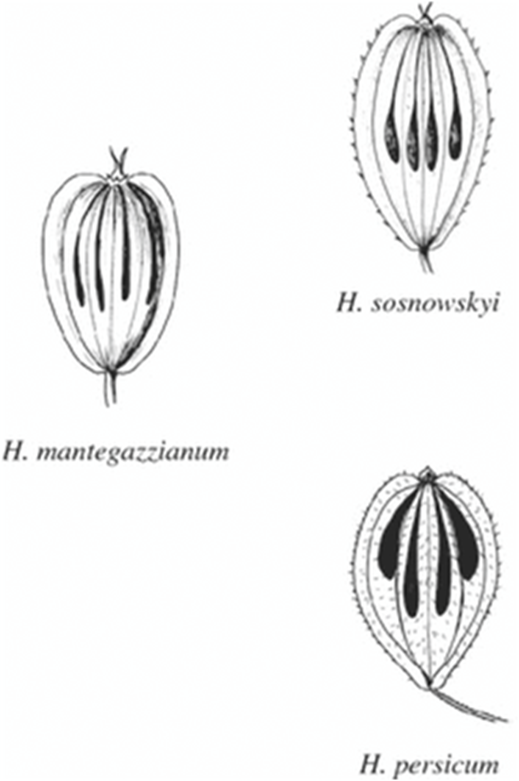
FIGURE 1
Drawings of H. mantegazzianum, H. sosnowskyi and H. persicum seeds by J. C. Schou (in Nielsen et al., 2005).
Heracleum sosnowskyi can easily be confused with H. mantegazzianum. Plants have a thick taproot and are usually smaller than those of H. mantegazzianum since they are up to 3 m tall instead of 5 (Nielsen et al., 2005). Heracleum sosnowskyi is distinguishable by having less divided leaves, the leaves of mature plants being divided to a varying extent, either into three approximately equal parts, which may themselves be similarly divided, or into more than three leaflets arranged in rows along the central rachis (pinnate). Outer petals are radiate, 9–10 mm long, while those of H. mantegazzianum are 12 mm long. The fine hirsute indumentum of the rays of the umbel is also characteristic of this species. Each compound umbel has 30–150 rays (Nielsen et al., 2005) and only short hairs. Fruits are oval to elliptical, broadly winged and comprise a pair of mericarps, which separate from each other before being shed, each containing a seed. Fruits from the terminal umbels tend to be smaller: some 10.5–16.5 mm long and 5.3–8.7 mm wide (Moravcová et al., 2007). Mature fruits are brown with swollen brown oil canals ¾ of the length of the fruits. This is a distinctive character of the species.
Heracleum spp. hybridize easily, thus causing confusion in identification. The common Heracleum species in Europe, H. sphondylium, H. sibiricum and the corresponding common species in the USA, H. montanum Bartr. (= H. lanatum Michx.) are not easily confused with the invasive hogweeds, being much smaller, rarely over 2 m high, with grey-green, pubescent and less acutely toothed leaves.BIOLOGY AND ECOLOGY 2026-04-09
General
Seeds germinate in early spring after morphophysiological dormancy is broken by the cold and wet conditions of autumn and winter. Autumn germination under favourable conditions may also be possible (though not observed), as seeds of H. sosnowskyi require a shorter period of cold stratification to break dormancy (2 months or less) than those of H. mantegazzianum (Moravcová et al., 2007). Experiments in the Czech Republic have shown that the seed bank is very quickly depleted by rapid germination in spring and seeds do not survive for more than one season. However, studies in regions where H. sosnowskyi is invasive are needed to verify this. Germination of H. sosnowskyi seeds under laboratory conditions is very high (71%–94% in different temperature regimes) (Moravcová et al., 2007).
Heracleum sosnowskyi produces from 15 000 to 20 000 seeds, weighing ca 12–14 mg, and even winged, the seed usually falls within a few metres from the mother plant (Krivosheina et al., 2020). In the climatic conditions of the Leningrad Region (Russia), about 50%–60% of seeds germinated after 60- to 70-day stratification, up to 12% in the second and third years after their sowing, and only a small fraction after 20- to 30-day stratification (Chadin et al., 2019). Stem leaves are compound leaves with long petioles and three to five divided leaflets. Leaf blades are 30–150 cm long and 30–120 cm wide. Umbels are numerous (usually 5–6, up to 10); the central umbel is the largest (up to 40 cm in diameter).
Flowering occurs from June to August. As with H. mantegazzianum, the flowers of H. sosnowskyi are insect pollinated, visited by a wide range of insects, including a number of Hymenoptera, Diptera and Coleoptera. The plant is reported to live up to 6 years when planted for biomass and silage production. Plants of H. sosnowskyi usually flower at 2–6 years (Dalke et al., 2023). The majority of seeds (98.2%) are distributed in the upper soil layer of 0–5 cm, with little in the deeper layers of 6–10 cm and 11–15 cm (Moravcová et al., 2007). Seeds are dispersed locally near the parent plants and over longer distances by watercourses. When the plant is established, its large size, fast growth and voluminous green mass suppress other plant species, so that it forms a single-species stand.
Habitats
The native range of H. sosnowskyi is in the Caucasus, where it grows in mountain areas alongside streams, in forests or in alpine meadows. The climate in the natural habitat is continental, with hot summers and cold winters. In other areas, H. sosnowskyi has been introduced as an agricultural crop and has spread rapidly, invading grasslands, forests, wetlands, riverbanks/canal sides, rail/roadsides, urban areas, as well as abandoned agricultural land, particularly in Latvia (Thiele et al., 2007).
Environmental requirements
Climatic preferences include temperate and cold climatic regions without a dry season, characterized by reasonable moisture and cold winters. Cold winters are required to ensure germination. Moist conditions are favoured for much of the year, but moderate summer droughts can be tolerated (Tiley et al., 1996). Recently, several studies focused on climate modelling were published, but most of the data come from GBIF or iNaturalist, so they predict a restricted spread to the east of Europe as a result of biased source data (Cuddington et al., 2022).
Heracleum sosnowskyi develops in fresh and slightly moist, neutral soils, rich in nutrients, in the pH range 6.3–7.0. Heracleum sosnowskyi communities have developed in artificial and seminatural habitats over the last 20 years. They are nitrophilous, and their expansion is stimulated by eutrophication of the environment (Laivins & Gavrilova, 2003). Heracleum sosnowskyi is a light-demanding plant, which cannot tolerate shade in the first growth stages (Oboļeviča, 2001). Nevertheless, it is considered more shade-tolerant than H. mantegazzianum (Nielsen et al., 2005).
Heracleum sosnowskyi, like H. mantegazzianum, is associated with areas with warm to hot wet summers and cool wet winters. It is considered to be more suited to continental climates and is not adapted to drier conditions. It is winter hardy down to −25°C. The new shoots of H. sosnowskyi are rather cold-resistant and can survive −4°C to −7°C. It is found that starting from the second year, they can survive up to −25°C, and under a snow cover, even down to −45°C (Oboļeviča, 2001). Seeds germinate in early spring (but not during summer) and require a period of cold stratification for breaking dormancy (<2 months). H. sosnowskyi easily colonizes anthropogenic and seminatural habitats because they feature open patches of disturbed soil required for the germination of its seeds. It relatively easily penetrates into natural habitats that include eroded areas, ravines and anthills not covered by plants. It rarely invades the communities with a dense, intact sod layer (Arepieva et al., 2021).Uses and benefits
Heracleum sosnowskyi has been cultivated for silage, biomass production and honey production in Russia and the Baltic States. Average yield of green matter reached 50–100 tonnes ha−1 in the third year of growing. Honey yield per plant was theoretically 12.7 g from one plant or 270 kg h a−1. In Russia, two cultivars were grown: ‘Uspekh’ and ‘Severzhanin’.
PATHWAYS FOR MOVEMENT 2026-04-09
The main pathway of introduction for all three species was plants for planting for use as ornamentals (especially for H. mantegazzianum) or as fodder crops or honey plants (especially for H. sosnowskyi in Russia and in the Baltic countries) (Laivinš & Gavrilova, 2003). Seeds may also be introduced involuntarily, as contaminants of soil and growing media, from used machinery, vehicles, plants for planting or footwear (EPPO, 2020).
Once introduced, Heracleum spp. reproduce very efficiently from seed, which are spread by wind (e.g. 4 m), water (up to several kilometres) and human activities (Laivinš & Gavrilova, 2003). Seeds can float along rivers for up to 3 days before they sink (Pyšek, 1994). In Latvia, seed has been observed to spread on frozen snow, where it forms a thin ice layer on the surface, and then wind can blow seeds over several kilometres (EPPO, 2020).
IMPACTS 2026-04-09
Effects on plants
There are no records of direct impact on crops. Heracleum mantegazzianum is not normally a weed of crops but there are reports of its encroachment into crop fields, for example in potatoes in Sweden, and it has also been seen invading pastures. In Latvia alone, the total cost of the 2006–2012 control program of this species was estimated at 12 million EUR (Cabinet of Ministers Order No. 426, 2006).
Heracleum persicum, as well as the two other Heracleum spp., block sunlight from penetrating to the undergrowth and suppress other vegetation. The leaves of H. persicum contain allopathic substances which may act as growth inhibitors on other plants as the leaves decompose (Myras, 1978).
For these species, significant costs are incurred by the measures taken to control the weed in amenity and other areas and to turn the land back to agriculture, and this activity is also likely to increase soil erosion along stream banks where they occur.
Heracleum spp. can create stands that may range in extent from square metres to hectares; small patches, linear stands or fringes can be found. The density of populations may also vary: in large stands, it ranges from sparse growth (1–3 adult individuals/10 m2) to almost entire ground cover (more than 20 adult individuals/10 m2) (Nielsen et al., 2005). The cover of H. mantegazzianum in the vegetation sampled in a German study varied between 1% and 95% (Thiele & Otte, 2007). In 31% of sampled plots, it was dominant, with cover exceeding 50%. The enormous height and leaf area of H. mantegazzianum are assumed to overgrow most (indigenous) plant species and hence to be in competition with them for light, absorbing up to 80% of incoming light in dense stands. A strong decline in species richness has been observed in abandoned grasslands and ruderal habitats in Latvia due to the presence of H. sosnowskyi (Nielsen et al., 2005). In amenity areas, established colonies compete strongly with and rapidly replace most other plants except trees. Along riverbanks, it can almost totally replace the natural vegetation and threaten biodiversity, including fauna associated with (native) plants, building a ‘giant hogweed landscape’ (Nielsen et al., 2005).
Nevertheless, since many stands of the species are linear, the biodiversity effects are often overestimated, as light can filter in from the sides (Starfinger & Kowarik, 2003). According to the study conducted in Germany by Thiele and Otte (2007), observed impacts on plant communities and local plant species richness are largely driven by successional changes following abandonment of land use or after large-scale disturbance. In the course of succession, competitive native tall herbs, such as Urtica dioica, have similar impacts on resident vegetation. Therefore, these impacts could be seen as symptoms of human-driven changes rather than a particular effect of H. mantegazzianum. Moreover, although H. mantegazzianum affects up to 10% of the area of suitable habitats in the study area, it appears that regional populations of native plant species have not been endangered until now, as these co-occurring species are very common.
Heracleum mantegazzianum can lead to riverbank erosion through the suppression or exclusion of native species, which play an important role in riverbank stabilization. When H. mantegazzianum plants in dense stands die off in winter, they leave bare soil that can be eroded by rainfall or winter floods. Deposition of eroded silt can alter substrate characteristics in rivers and, for example, render gravel substrates unsuitable for salmonid spawning (Thiele & Otte, 2007).
Environmental and social impact
Hybrids are possible in the genus Heracleum (Gavrilova, 2003). Hybrids between H. mantegazzianum and native H. sphondylium are reported from Great Britain (McClintock, 1975) and Germany (Ochsmann, 1996). They are found in sites where the two species grow together, although they are not numerous (Grace & Nelson, 1981; Stewart & Grace, 1984). Hybridization of both H. mantegazzianum and H. sosnowskyi with the native Heracleum sibiricum is expected in Lithuania (pers. comm. Z. Gudžinskas). Hybridization between H. mantegazzianum and H. sosnowskyi is possible (Klingenstein, 2006).
Heracleum mantegazzianum, H. sosnowskyi and H. persicum contain photosensitizing furanocoumarins. In contact with the human skin and in combination with ultraviolet light, a toxic reaction can occur 15 min after contact, with a sensitivity peak between 30 min and 2 h causing burning of the skin. After about 24 h, flushing or reddening of the skin (erythema) and excessive accumulation of fluid in the skin (edema) appear, followed by an inflammatory reaction after 3 days. Approximately 1 week later, a hyper-pigmentation (usually darkening of the skin) occurs, which can last for months. The affected skin may remain sensitive to ultraviolet light for years. Although such photosensitized toxic reactions can be caused by other plants in the EPPO region, these Heracleum sp. are particularly dangerous because of the high intensity of the reactions and the large size of the plants. The public is not generally aware that such risks exist, so these plants present a real hazard, especially to children.
Dense infestations can seriously interfere with access to amenity areas, riverbanks, etc., and along roadsides, large stands can reduce visibility and result in road safety hazards. Obstruction of lake shores and riverbanks by stands of H. mantegazzianum affects anglers, water sports enthusiasts, swimmers, bird watchers, hikers and those working along river systems (Thiele & Otte, 2007). The costs of maintenance of roads may increase due to H. sosnowskyi (A. Garkaje, pers. comm., 2008).
Cultivation of H. sosnowskyi as a forage plant was eventually abandoned in the Baltic States at the end of the 1980s as agricultural production systems and markets changed, partly because the aniseed-scented plants affected the flavour of the meat and milk of the animals to which they were fed, and partly because of the health risk to humans and cattle (Nielsen et al., 2005).
A German study from 2003 assessed the economic impact of H. mantegazzianum to be more than 12 million EUR annually in the country, distributed among the health system (1050000 EUR), nature reserves (1170000 EUR), road management (2340000 EUR), municipal management (2100000 EUR) and district management (5600000 EUR) (Reinhardt et al., 2003).
CONTROL 2026-04-09
The EPPO Standard PM 9/9 (2) Heracleum mantegazzianum, H. sosnowskyi and H. persicum describes the control procedures aiming to contain and eradicate the three species.
Additional information can be found in Pergl (2017) and Rajmis et al. (2017).
Some countries developed dedicated legislation acts specifying control measures for these Heracleum species (e.g. Czech Republic https://invaznidruhy.aopk.gov.cz/zasady-regulace).
REGULATORY STATUS 2026-04-09
In the United Kingdom, legislation requires that landowners should control the plant and prevent further spread (Willoughby, 1996). Heracleum sosnowskyi is regulated in Estonia, Latvia and Lithuania. In Latvia, the legislation requires that landowners should control the plant and prevent further spread. In Sweden, there is control legislation for H. mantegazzianum based on the Plant Protection Act.
Heracleum sosnowskyi is on the EPPO A2 list of pests recommended for regulation and is listed as (EU) species of Union concern.
PHYTOSANITARY MEASURES
All three Heracleum species are listed as (EU) species of Union concern, and as such their sale is prohibited and their movement in the EU is restricted. Phytosanitary measures for existing populations and preventing spread include managing the pathways. This can include preventing spread via unintentional transport of seeds or contaminated soils. Early detection is required to prevent the establishment of new populations and allow rapid eradication. Management practices can follow those detailed in the control section.
REFERENCES 2026-04-09
All websites were accessed in April 2026.
Alm T (1988) Floaraen i Tromsø by. Floristisk sluttrapport prosjektet Planteliv i Tromsø. Polarflokken 12(1), 1–156.
Alm T & Jensen C (1993) Tromsøpalmen (Hercleum lacinatum auct. Scand.) noen kommentarer till artens innkomst og ekoansjon i Nord-Norge. Blyttia 51, 61–69.
Andersen UV & Calov B (1996) Long-term effects of sheep grazing on giant hogweed (Heracleum mantegazzianum). In: Management and Ecology of Freshwater Plants (Ed. Caffrey JM, Barrett PRF, Murphy KJ & Wade PM), Proceedings, 9th International Symposium on Aquatic Weeds, European Weed Research Society, Dublin, 1994. Hydrobiologia 340, 277–284.
Arepieva LA, Arepiev EI, Kazakov SG (2021) Distribution of Sosnowsky's Hogweed (Heracleum sosnowskyi Manden.) at the southern border of its secondary range in European Russia. Russian Journal of Biological Invasions 12, 233–243.
Cabinet of Ministers Order No. 426 (2006) On Distribution Control Program of Giant Hogweed for the Period of 2006–2012.
Cock MJW & Seier MK (2007) The scope for biological control of Giant Hogweed, Heracleum mantegazzianum (chapter 16). In: Ecology and management of Giant Hogweed (Heracleum mantegazzianum) (Ed. Pysek P, Cock MJW, Nentwig W & Ravn HP), pp. 255–271. CAB International, Wallingford (GB).
Cuddington K, Sobek-Swant S, Drake J, Lee W, Brook M (2022) Risks of giant hogweed (Heracleum mantegazzianum) range increase in North America. Biological Invasions 24, 299–314
Daehler CC (1998) Variation in self-fertility and the reproductive advantage of self-fertility for an invading plant (Spartina alterniflora). Evolutionary Ecology 12, 553–568.
EPPO (2020) PM 9/9 (2) Heracleum mantegazzianum, H. sosnowskyi and H. persicum. EPPO Bulletin 50 (3), 515–524
Falahati-Anbaran M, Rijal DP, Lundemo S, Alsos IG, Stenøien HK (2021) Disentangling the genetic origin of Heracleum persicum (Apiaceae) in Europe: multiple introductions from multiple source populations. Biological Invasions 23(12), 3871-3890
Fremstad E & Elven R (2006) The alien giant species of Heracleum in Norway. NTNU Norges teknisk-naturvetenskaplige universitet Vitenskapsmuseet Rapport bottanisk serie 2, 1–35.
Gavrilova G (2003) Report on investigation of Heracleum in Latvia in 2003. Institute of Biology, Rija (LV).
Grace J & Nelson M (1981) Insects and their pollen loads at a hybrid Heracleum site. New Phytologist 87, 413–423.
Gudžinskas Z, Kazlauskas M (2022) The first record of Heracleum mantegazzianum Sommier & Levier (Apiaceae) in Lithuania. BioInvasions Records 11(2), 320–329
Jahodová Š, Trybush S, Pyšek P, Wade W, Karp A (2007a) Invasive species of Heracleum in Europe: an insight into genetic relationships and invasion history. Diversity & Distributions 13(1), 99–114.
Jahodova S, Froberg L, Pysek P, Geltman D, Trybush S, Karp A (2007b) Taxonomy, identification, genetic relationship and distribution of large Heracleum species in Europe (Chapter 1). In: Ecology and Management of Giant Hogweed (Heracleum mantegazzianum) (Ed. Pysek P, Cock MJW, Nentwig W & Ravn HP), pp. 1–19. CAB International, Wallingford (GB).
Kabuce N (2006) NOBANIS – Invasive Alien Species Fact Sheet –Heracleum sosnowskyi.
Krivosheina MG, Ozerova NA, Petrosyan VG (2020) Distribution of seeds of the Giant Hogweed (Heracleum sosnowskyi Manden.) in the winter period. Russian Journal of Biological Invasions 11, 318–325.
McClintock D (1975) Heracleum L. In: Hybridization and the Flora of the British Isles (Ed. Stace CA), pp. 270. Academic Press, London (GB).
Moravcova L, Pysek P, Krinke L, Pergl J, Perglova I & Thompson K (2007) Seed germination, dispersal and seed bank in Heracleum mantegazzianum (chapter 5). In: Ecology and Management of Giant Hogweed (Heracleum mantegazzianum) (Ed. Pyšek P, Cock MJW, Nentwig W & Ravn HP), pp. 74–91. CAB International, Wallingford (GB).
Myras H (1978) Interaksjon mellom planter med saerlig vekt paallelopati. Undersøkning av interaksjon mellom Heracleum lacinatum Horn Tromsøpalme og andra planter. Hovedfagsoppgave Universitetet i Tromsø 226 s.
NAPIS (2004) Heracleum mantegazzianum, giant hogweed reported surveys. The Center for Environmental and Regulatory Information Systems, Purdue University (US).
Neiland MRM (1986) The distribution and ecology of Giant Hogweed (Heracleum mantegazzianum) on the river Allan, and its control in Scotland. Thesis, University of Stirling (GB).
Nielsen C, Ravn HP, Nentwig W & Wade M (Ed.) (2005) The Giant Hogweed Best Practice Manual. Guidelines for the management and control of an invasive weed in Europe. Forest and Landscape Denmark, Hoersholm, 44pp.
Oboļeviča D (2001) Hogweed and its distribution in Latvia.
Ochsmann J (1996) Heracleum mantegazzianum Sommier & Levier (Apiaceae) in Germany. Studies on biology, distribution, morphology and taxonomy. Feddes Repertorium 107(7–8), 557–595.
Often A & Ericssonn S (1996) Tromsoloka, Heracleum ‘lacinatum’, naturalised i Sverige. Heracleum lacinatum, naturalized in Sweden. Svensk Botanisk Tidskrift 90, 17–19.
Otte A & Thiele J (2007) Heracleum mantegazzianum in its primary distribution range of the Western Greater Caucasus. In: Ecology and Management of Giant Hogweed (Heracleum mantegazzianum) (Ed. Pysek P, Cock MJW, Nentwig W & Ravn HP), pp. 20–41. CAB International, Wallingford (GB).
Pergl J (2017) Information on measures and related costs in relation to species included on the Union list: Heracleum mantegazzianum. Technical note prepared by IUCN for the European Commission. https://circabc.europa.eu/sd/a/a174ceae-558c-4aa1-8437-e28cb310275d/TSSR-2016-003%20Heracleum%20mantegazzianum.pdf
Pergl J, PerglovaI, Pyšek P & Dietz H (2006) Population age structure and reproductive behaviour of the monocarpic perennial Heracleum mantegazzianum (Apiaceae) in its native and invaded distribution ranges. American Journal of Botany 93(7), 1018–1028.
Pergl J, Pyšek P, Perglová I & Jarošík V (2012) Low persistence of a monocarpic invasive plant in historical sites biases our perception of its actual distribution. Journal of Biogeography 39, 1293–1302. https://doi.org/10.1111/j.1365-2699.2011.02677.x
Perglova I, Pergl J & Pyšek P (2007) Reproductive strategy of Heracleum mantegazzianum (chapter 4). In: Ecology and Management of Giant Hogweed (Heracleum mantegazzianum) (Ed. Pysˇek P, Cock MJW, Nentwig W & Ravn HP), pp. 55–73. CAB International, Wallingford (GB).
Pyšek P (1994) Ecological aspects of invasion by Heracleum mantegazzianum in the Czech Republic. In: Ecology and Management of Invasive Riverside Plants (Ed. De Waal LC, Child EL, Wade PM & Brock JM), pp. 45–54. John Wiley & Sons, Chichester (GB).
Pyšek P, Kopecký M, Jarošík V & Kotková P (1998) The role of human density and climate in the spread of Heracleum mantegazzianum in the Central European landscape. Diversity and Distributions 4, 9–16.
Pyšek P & Prach K (1993) Plant invasions and the role of riparian habitats: a comparison of four species alien to central Europe. Journal of Biogeography 20(4), 413–420.Pyšek P & Pysek A (1995) Invasion by Heracleum mantegazzianum in different habitats in the Czech Republic. Journal of Vegetation Science 6(5), 711–718.
Pyšek P, Müllerová J & Jarošík V (2007) Historical dynamics of Heracleum mantegazzianum invasion at regional and local scales. In: Ecology and Management of Giant Hogweed (Heracleum mantegazzianum) (Ed. Pyšek P, Cock MJW, Nentwig W & Ravn HP), pp. 42–54. CAB International, Wallingford (GB).
Pyšek P, Sádlo J, Chrtek J Jr, Chytrý M, Kaplan Z, Pergl J, Pokorná A, Axmanová I, Čuda J, Doležal J, Dřevojan P, Hejda M, Kočár P, Kortz A, Lososová Z, Lustyk P, Skálová H, Štajerová K, Večeřa M, Vítková M, Wild J & Danihelka J (2022) Catalogue of alien plants of The Czech Republic (3rd edition): species richness, status, distributions, habitats, regional invasion levels, introduction pathways and impacts. Preslia 94, 477–577. https://doi.org/10.23855/preslia.2022.447
Rajmis S, Thiele J, Marggraf R (2016) A cost-benefit analysis of controlling giant hogweed (Heracleum mantegazzianum) in Germany using a choice experiment approach. NeoBiota 31, 19–41.[MS1][MS2] https://doi.org/10.3897/neobiota.31.8103
Rejmánek M, Richardson DM, Higgins SI, Pitcairn MJ, Grotkopp E (2005) Ecology of invasive plants: state of the art. In: Invasive Alien Species: Searching for Solutions (Ed. Mooney HA, Mack RM, McNeely JA, Neville L, Schei P & Waage J), pp. 104–161. Island Press, Washington, DC (US).
Reinhardt F, Herle M, Bastiansen F & Streit B (2003) Economic Impact of the Spread of Alien Species in Germany. Environmental Research of the Federal Ministry of the Environment, Nature Conservation and Nuclear Safety, Research Report 201 86 211 UBA-FB 000441e, Texte Nr. 80 ⁄ 2003. Federal Environmental Agency (Umweltbundesamt), Berlin (DE), 229p.
Seier MK, Wittenberg R, Ellison CA, Djeddour DH & Evans HC (2003) Surveys for natural enemies of giant hogweed (Heracleum mantegazzianum) in the Caucasus region and assessment for their classical biological control potential in Europe. In: Proceedings XI International Symposium on Biological Control of Weeds, Canberra, Australia (Ed. Cullen JM, Briere DT, Kritikos DJ, Londsdale WM, Morin L & Scott JK), pp. 149–154. CSIRO, Melbourne (AU).
Sell P & Murrell G (2009) Flora of Great Britain and Ireland Vol. 3, Mimosaceae – Lentibulariaceae. Cambridge University Press, Cambridge (GB).
Starfinger U & Kowarik I (2003) Heracleum mantegazzianum Sommier & Levier (Apiaceae), Riesen-Barenklau. In: NeoFlora (Ed. Bundesamt f. Naturschutz).
Stewart F & Grace J (1984) An experimental study of hybridization between Heracleum mantegazzianum Somm & Levier and H. sphondylium (Umbelliferae). Watsonia 15, 73–83.
Tkachenko KG (1989) Peculiarities and seed productivity in some Heracleum species grown in Leningrad area. Rastitelnye Resursy 1, 52–61. [In Russian.]
Thiele J, Otte A & Lutz Eckstein R (2007) Ecological needs, habitats preferences and plant communities invaded by Heracleum mantegazzianum. In: Ecology and Management of Giant Hogweed (Heracleum mantegazzianum) (Ed. Pysek P, Cock MJW, Nentwig W & Ravn HP), pp. 126–143. CAB International, Wallingford (GB).
Thiele J & Otte A (2007) Impact of Heracleum mantegazzianum on invaded vegetation and human activities. In: Ecology and Management of Giant Hogweed (Heracleum mantegazzianum) (Ed. Pysek P, Cock MJW, Nentwig W & Ravn HP), pp. 144–156. CAB International, Wallingford (GB).
Tiley GED, Dodd FS & Wade PM (1996) Heracleum mantegazzianum Sommier & Levier. Journal of Ecology (Oxford) 84(2), 297–319.
USDA-NRCS (2026) Heracleum mantegazzianum Sommier & Levier. Accessed Date: February 2026. https://plants.usda.gov/plant-profile/HEMA17/noxious-invasiveWestbrooks RG (1991) Heracleum mantegazzianum Sommier & Levier. Federal USDA PPQ Noxious Weed Inspection Guide. Purdue University, West Lafayette, Indiana, USA.
Willis SG & Hulme PE (2002) Does temperature limit the invasion of Impatiens glandulifera and Heracleum mantegazzianum in the UK? Functional Ecology 16(4), 530–539.
Willoughby I (1996) Noxious weeds. Research Information Note – Forestry Authority Research Division 274, 8.
Zakhozhiy IG, Dalke IV, Chadin IF, Kanev VA (2022) Ecogeographical analysis of the Heracleum persicum, H. mantegazzianum, and H. sosnowskyi distribution at the northern limit of their secondary ranges in Europe. Russian Journal of Biological Invasions 13, 203–214. https://doi.org/10.1134/S2075111722020138
ACKNOWLEDGEMENTS 2026-04-09
This datasheet was extensively revised in 2025 by the Dragana Marisavljevic Institute for Plant Protection and Environment, Serbia and Jan Pergl Institute of Botany, Czech Republic. Their valuable contribution is gratefully acknowledged.
How to cite this datasheet?
Datasheet history 2026-04-14
This datasheet was first published in the EPPO Bulletin in 2009 and revised in 2025. It is now maintained in an electronic format in the EPPO Global Database available at https://gd.eppo.int. The sections on ‘Identity’ and ‘Geographical distribution’ are automatically updated from the database in the online version of the datasheet.
EPPO (2009) Datasheets on pests recommended for regulation. Heracleum mantegazzianum, Heracleum sosnowskyi and Heracleum persicum. EPPO Bulletin 39, 489-499 https://doi.org/10.1111/j.1365-2338.2009.02313.x
EPPO (2026) Datasheets on pests recommended for regulation. Heracleum mantegazzianum, Heracleum sosnowskyi and Heracleum persicum. EPPO Bulletin 56(1), 108-119 https://doi.org/10.1111/epp.70049